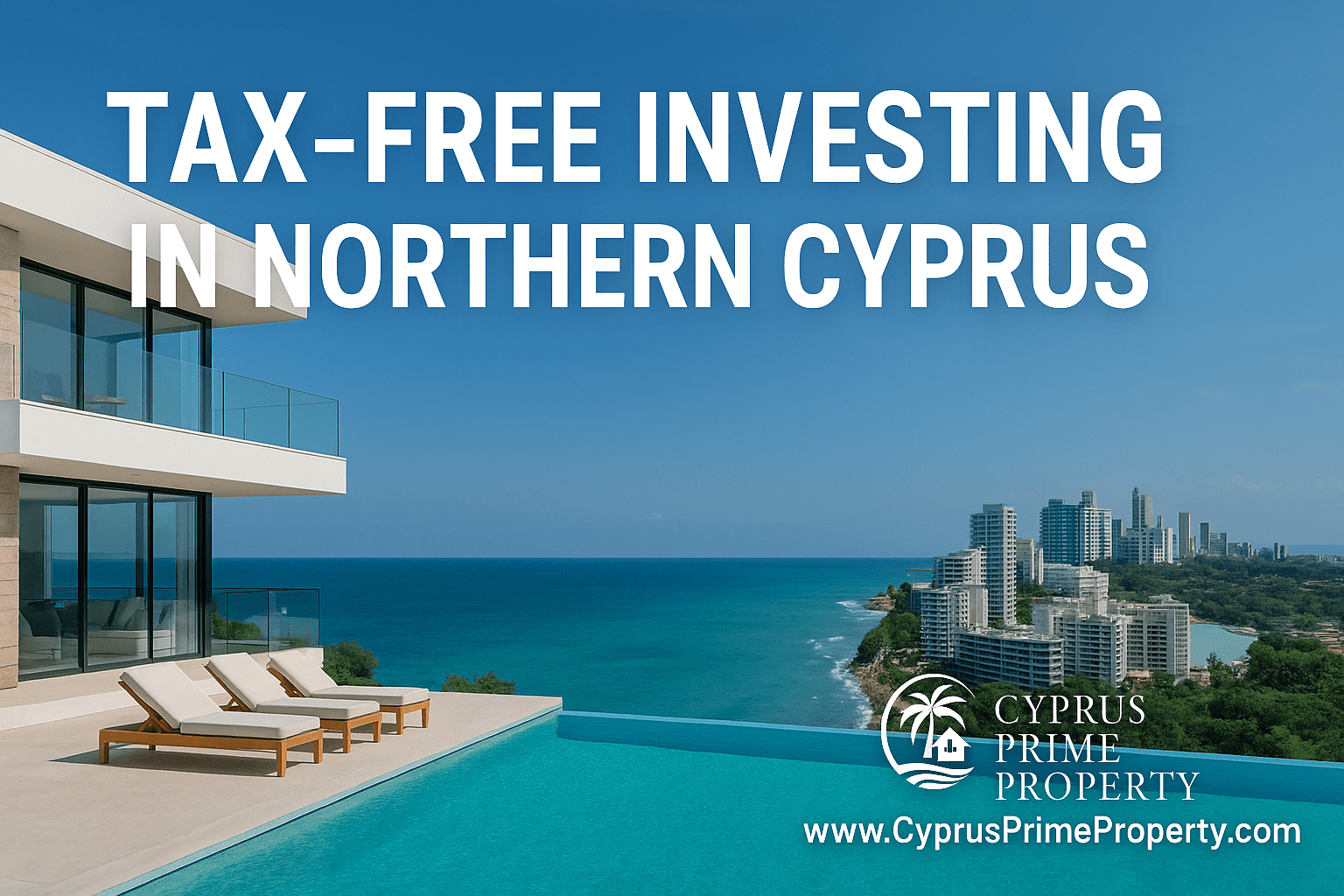
Northern Cyprus offers one of the most investor-friendly environments in the Mediterranean: attractive purchase prices, flexible payment options (including crypto), and highly favorable taxation for foreign buyers. This guide explains the key fiscal advantages, how to structure a purchase, and realistic return scenarios—so you can invest confidently and efficiently.
Why Northern Cyprus stands out for foreign investors
-
Favorable tax environment: widely perceived as highly efficient for property ownership and exits compared with many EU destinations.
-
Flexible payments: many developers accept EUR, USD, GBP—and increasingly, cryptocurrency—alongside staged payment plans.
-
Residency pathway: property purchase can qualify you for a multi-year residence permit, enabling year-round living.
-
Undervalued market: sea-view apartments from around €89,000 and villas from c. €295,000 in prime coastal areas (e.g., Iskele/Long Beach, Esentepe).
-
Lifestyle + yield: 340+ sunny days per year support both short-let and long-term rental demand.
Note: Tax frameworks can change; always confirm details with a qualified local advisor before purchasing.








The fiscal advantages—what “tax-free” can mean in practice
Foreign buyers are drawn by a light overall tax burden relative to many European markets. In practice, this often includes:
-
Efficient acquisition costs
-
Purchase taxes/fees are typically straightforward and transparent (stamp duties, transfer costs, and registry fees apply).
-
New builds may have different cost components vs. resales—your lawyer will model these before contract exchange.
-
-
Favorable holding phase
-
No annual wealth tax on real estate.
-
No tax on unrealized gains.
-
Local property charges (where applicable) are generally modest compared with Western Europe.
-
-
Exit efficiency
-
Capital gains on disposal of the property can be structured very efficiently under local rules; many investors experience materially lower exit taxation than in EU countries.
-
No tax on crypto gains (outside the property transaction itself) is a frequent draw for crypto-native investors managing global portfolios.
-
-
Currency flexibility
-
You can often transact in EUR/USD/GBP and sometimes crypto (e.g., USDT/USDC/BTC)—useful for FX hedging and liquidity management.
-
Your lawyer should provide a line-by-line schedule of purchase costs, ongoing charges, and exit mechanics before you commit.
Worked examples: what the numbers can look like
Example A — Sea-view apartment (Iskele / Long Beach)
-
Purchase price: €120,000 (new build, 1-bed)
-
Letting strategy: 10 months long-let + 2 months short-let
-
Gross annual rent: €11,400 (long-let €850×10) + €3,600 (short-let €180×20 nights) = €15,000
-
Operating costs: ~€2,800 (community, utilities during voids, marketing, maintenance)
-
Indicative net: €12,200 → 6.8% net yield
-
Five-year value growth (illustrative): 8% p.a. compounding → exit value ≈ €176,000
-
Outcome: rental cash flow + potential capital uplift with efficient exit taxation relative to many EU markets.
Example B — Villa with pool (Esentepe)
-
Purchase price: €320,000
-
Letting strategy: seasonal short-lets, 22 high-season weeks at €1,250/week
-
Gross annual rent: €27,500
-
Operating + management: ~€6,500
-
Indicative net: €21,000 → 6.6% net yield
-
Five-year growth (illustrative 7% p.a.): exit value ≈ €449,000
Figures are examples, not guarantees. Actual outcomes vary by unit, location, furnishing, and operator.
Residency via property: the lifestyle dividend
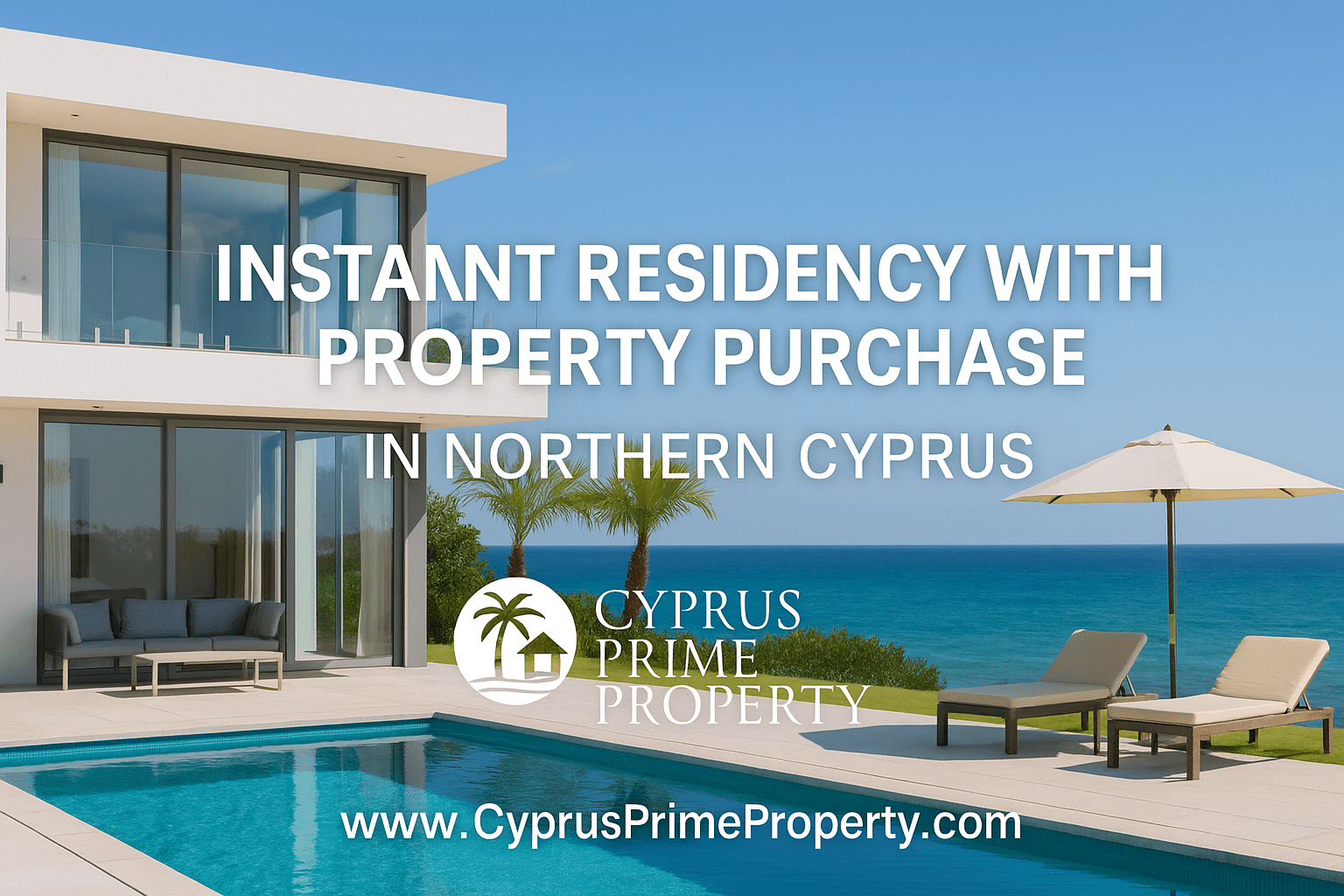
Purchasing property can qualify you for a multi-year residence permit (commonly up to five years, renewable). This simplifies year-round living, schooling, healthcare access, vehicle registration, and local banking—turning a financial investment into a complete lifestyle play.
Payment structures foreign buyers use
-
Staged payments on off-plan projects (e.g., 30–35% on contract; the balance over construction milestones).
-
Cash or mortgage (local options exist; many investors prefer staged developer finance).
-
Crypto settlement where offered—typically via a compliant escrow or PSP pathway, then converted to fiat for title registration.
Best practice: route any crypto leg through a lawyer-controlled process with clear KYC/AML, a dated receipt, and contract addendum covering FX/price equivalence.
Rechtliche und eigentumsrechtliche Sicherheiten
Um die Steuer- und Investitionsvorteile zu erhalten, strukturieren Sie Ihren Kauf von Anfang an korrekt:
- Unabhängiger Anwalt (nicht der Hausanwalt des Entwicklers).
- Reservierungs- & Kaufverträge mit klarem Meilensteinplan, Strafen, Mängelbeseitigung und Übergabe.
- Due Diligence bezüglich Eigentumstitel, Entwickler-Referenzen, Versorgungsleistungen und Eigentumswohnung/Vorschriften.
- Fertigstellung & Registrierung: stellen Sie sicher, dass Ihr Eigentumstitel/Vertrag ordnungsgemäß registriert ist, um Ihre Rechte zu schützen.
- Steuermemo: bitten Sie Ihren Anwalt um ein einseitiges Memo, das Anschaffungs-/Halte-/Exit-Kosten und anwendbare Erleichterungen zusammenfasst.
Nordzypern im Vergleich mit beliebten EU-Destinationen
| Faktor | Nordzypern | Spanien/Portugal/Griechenland (typisch) |
|---|---|---|
| Einstiegspreise (Meerblick-Neubau) | Ab ~89.000 € | Oft 200.000–400.000 €+ |
| Steuer auf Krypto-Gewinne (außerhalb von Immobilien) | Häufig nicht besteuert | Oft als Kapitalgewinne besteuert |
| Jährliche Vermögenssteuer | Nicht zutreffend | Kann in einigen Jurisdiktionen zutreffen |
| Residenz durch Immobilienbesitz | Vereinfachte mehrjährige Genehmigung | Golden Visa Optionen in vielen Staaten eingeschränkt/geändert |
| Nettomietrenditen (Küste) | ~5,5–7,5 % üblich bei gutem Management | Oft ~3–5 % an erstklassigen EU-Küsten |
Tabelle ist indikativ; aktuelle Regeln lokal überprüfen.
Checkliste Risikomanagement
- Bevorzugen Sie etablierte Entwickler mit abgeschlossenen Projekten und Vor-Ort-Management.
- Legen Sie Preise in EUR/USD/GBP fest, um die FX-Volatilität zu reduzieren, wenn Ihr Einkommen nicht in lokaler Währung ist.
- Modellieren Sie konservative Auslastung (z. B. 55–60 % im ersten Jahr).
- Nutzen Sie professionelles Management für Compliance, Mieterwechsel und Gästekommunikation.
- Halten Sie einen Notfallfonds (1–2 % des Immobilienwerts) für Wartung und Investitionsausgaben.
Wie Cyprus Prime Property ausländischen Käufern hilft
- Access to vetted, on-time developers in Iskele, Kyrenia, Esentepe, and Famagusta.
- Direkte Vergleiche von Zahlungsplänen, Grundrissen und Mietprognosen.
- Legal and residency coordination with trusted local counsel.
- After-Sales-Support: Mängelbeseitigung, Möblierung, mietfertige Einrichtung und Management-Einführungen.
- Krypto-freundliche Wege wo verfügbar und konform.
Fazit
For foreign investors who value both financial efficiency and quality of life, Northern Cyprus offers a combination that is increasingly rare: accessible prices, flexible payment methods, favorable taxation, and real lifestyle upside. With the right legal structure and project selection, the result can be a tax-efficient, high-sunshine asset that performs in every cycle.
What “Tax-Free” Really Means — and What It Does Not
The phrase “tax-free” is used loosely across the North Cyprus property market, and it is worth being precise, because the reality is genuinely attractive without needing exaggeration. Buying property in the TRNC does attract charges: stamp duty of roughly 0.5% of contract value, VAT of around 5%, and a title deed transfer fee of approximately 6%, which is frequently reduced for a buyer’s first purchase in their own name. Those are real, budgetable costs, and any serious return calculation should include them from day one.
Where the advantage genuinely lies is in what happens after the purchase. Ongoing municipal property charges are modest by Western European standards, there is no annual wealth tax on property of the kind found in several EU states, and the TRNC does not levy inheritance tax in the way many European countries do. In addition, foreign-sourced income that is not transferred into the TRNC is generally not taxed locally — a meaningful benefit for internationally mobile investors, but a specific rule with conditions rather than a blanket exemption.
Rental income arising within the TRNC is taxed progressively, broadly in the 10%–37% range depending on the amount earned, with allowable deductions influencing the effective rate. That is still competitive against many European jurisdictions, but it is not zero, and modelling a project on the assumption of untaxed rent will overstate your net yield.
Your Home Country Still Matters
This is the single most overlooked factor among foreign buyers. If you remain tax resident in Germany, the UK, Sweden, the Netherlands or most other European countries, you are generally taxed on your worldwide income and gains. Local efficiency in the TRNC does not switch off that obligation. Rental income usually needs declaring at home, and disposal proceeds may be assessable there too.
Whether you can offset tax already paid in the TRNC depends on your domestic rules. Because the TRNC’s international recognition is limited, double-taxation treaty coverage cannot be assumed and must be verified for your specific situation. Investors who plan both sides of the equation from the outset consistently achieve better outcomes than those who optimise locally and deal with the home-country position afterwards.
Frequently Asked Questions
Is buying property in Northern Cyprus genuinely tax-free?
Not literally. Purchases attract stamp duty (~0.5%), VAT (~5%) and a title deed transfer fee (~6%). What is accurate is that the overall burden is comparatively low and simple: modest annual charges, no inheritance tax in the TRNC, and foreign-sourced income not remitted into the TRNC generally untaxed locally. That is a strong proposition on its own without the “tax-free” shorthand.
What will I actually pay at purchase?
Budget for the three one-off charges above, plus legal fees and, for off-plan purchases, any developer-side administrative costs. Who bears which cost varies by contract, so request a written breakdown before signing and have your own lawyer confirm it. First-purchase reductions on the transfer fee may apply, but should be checked rather than assumed.
How is my rental income taxed?
TRNC-sourced rental income falls under progressive personal income tax, broadly 10%–37% depending on the level of income, with deductions affecting the effective rate. You will also usually need to declare that income in your country of residence, so your final position depends on both jurisdictions together.
Do I get residency automatically when I buy?
No. Property ownership can support a residence permit application and many buyers do obtain permits, but it is a separate process with its own criteria and renewals. Requirements change over time, so treat residency as a distinct application rather than an automatic by-product of purchase.
Can I really pay in cryptocurrency?
Some developers do accept crypto settlement, and it has become more common in the market. However, acceptance varies by project, conversion and valuation terms must be agreed in writing, and your home-country reporting obligations on crypto disposals still apply. Confirm the mechanism contractually before relying on it.
Is my ownership secure as a foreign buyer?
Security depends heavily on the title deed category attached to the specific property and on the quality of your due diligence. This is the area where independent legal advice matters most. Read our detailed guide on whether buying property in North Cyprus is safe before committing to any project.
What net yield is realistic?
Realistic modelling starts from gross rent and then subtracts management fees, vacancy periods, maintenance, communal charges and tax. Headline gross yields quoted in marketing material rarely reflect that. Our ROI and cashflow calculator lets you test your own assumptions rather than relying on averages.
Should I buy in my own name or through a company?
For a single property, private ownership is usually simpler and cheaper. Corporate structures can be justified for larger portfolios but add setup cost, administration and reporting duties in more than one jurisdiction. Model the comparison with a qualified adviser before purchase, since restructuring afterwards is expensive.
Important Note on Tax and Legal Advice
This article provides general information about the Northern Cyprus property market and is not tax, legal or financial advice. Rates, thresholds, reliefs and administrative practice change over time, and the figures quoted here are indicative. Your own outcome depends on your residence status, personal circumstances, the structure of the purchase and the specific contract you sign. Before committing, obtain independent advice from a qualified tax adviser and an independent lawyer covering both the TRNC and your country of residence. Cyprus Prime Property is a real estate agency, not a tax or legal adviser.



Treten Sie der Diskussion bei