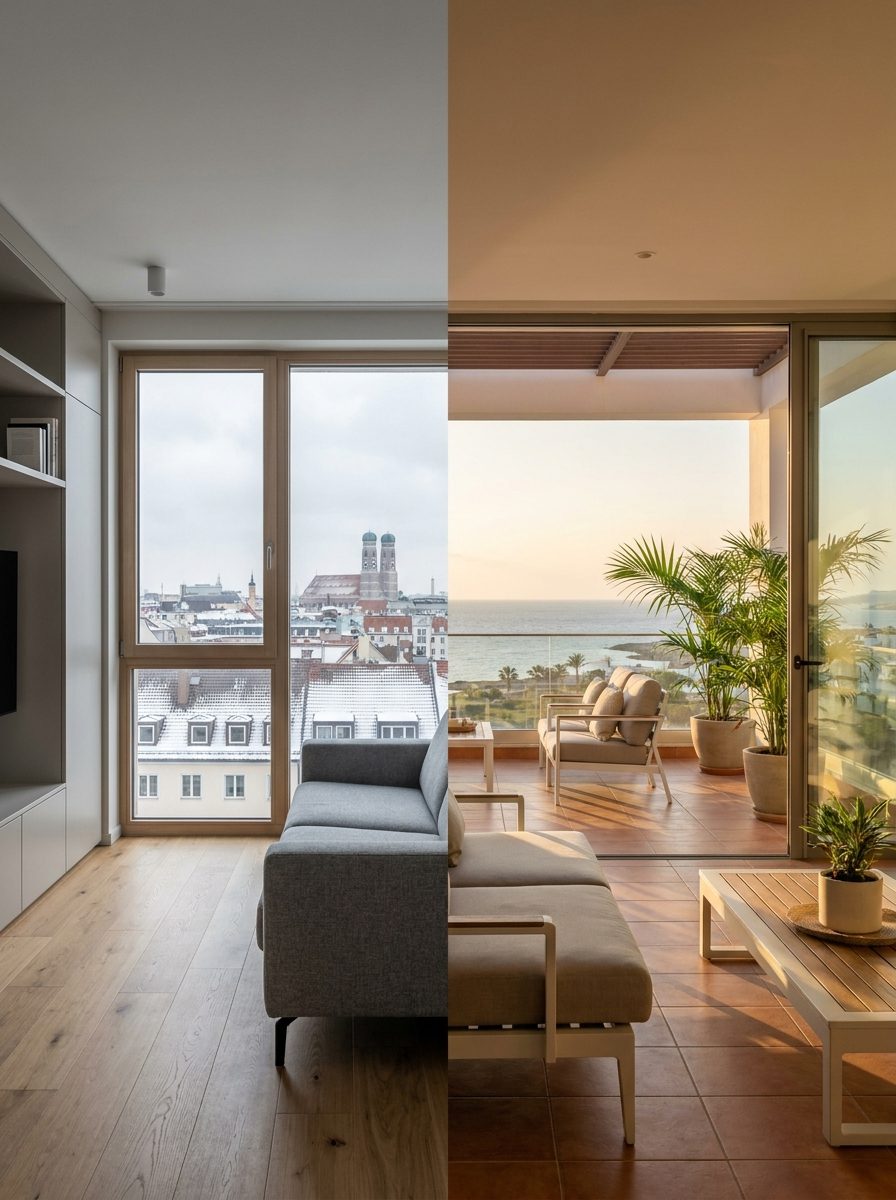
Munich averages around €7,500–€8,100 per square metre for apartments as of July 2026, according to major German property portals such as ImmoScout24 and immowelt. In Iskele, Northern Cyprus, current listings for new-build apartments typically sit well below that figure — but a direct comparison needs important context before drawing conclusions. This article breaks down what the numbers actually mean, what a comparable budget buys in each location, and the legal and structural differences buyers need to understand before treating “cheaper” as automatically “better.”
Munich property prices: the current picture
Munich remains one of Germany’s most expensive residential markets, and the numbers reflect that. Multiple independent property portals report broadly consistent figures for mid-2026:
- ImmoScout24 places the average apartment price at approximately €7,829/m², with premium units reaching up to €18,954/m² and the most affordable listings starting around €5,786/m².
- immowelt reports a citywide average of €8,078/m² for apartments, with entry-level listings from around €4,936/m².
- McCompass (McMakler) cites an average of €7,579/m² for apartments, with a spread from €3,898/m² to €12,299/m² depending on district and condition.
Taken together, a realistic planning figure for a standard Munich apartment sits in the €7,500–€8,100/m² range, with significant variation by district. Neighbourhoods such as Obermenzing, Solln and Waldtrudering trade closer to €6,850–€7,700/m², while central and premium districts easily exceed €9,000–€12,000/m². Even at the lower end of the citywide range, a modest one-bedroom apartment on the outskirts of Munich represents a substantial capital outlay for most buyers — often €200,000–€350,000 for a compact unit, before purchase costs.
It’s also worth noting the recent trend: after a correction of roughly 10–12% from the 2022 peak, Munich apartment prices have stabilised and shown modest renewed growth (around +0.5% to +1.5% year-on-year through 2025 and into 2026), according to multiple market reports. In short, Munich is not getting meaningfully cheaper.
Iskele property prices: a different market structure
Northern Cyprus does not have an official government or central-bank property price index comparable to Germany’s Federal Statistical Office data or the Republic of Cyprus’s RICS/Central Bank of Cyprus index. This is an important distinction: many “Cyprus property price” statistics circulating online — including well-cited RICS/KPMG data and Central Bank of Cyprus figures — refer specifically to the Republic of Cyprus (the EU member state in the south of the island), not to the Turkish Republic of Northern Cyprus (TRNC), where Iskele is located. Applying southern Cyprus statistics to Iskele would be factually incorrect, and we do not do that here.
What we can say, based on current market listings for new-build developments in Iskele, is that per-square-metre prices are typically a fraction of Munich’s average — often in a range that puts a modern one- or two-bedroom apartment with sea proximity within a budget that would only cover a compact studio in central Munich. However, these figures are directional and vary substantially based on:
- Construction phase — off-plan and early-phase units are typically priced lower than near-completion or ready-to-move-in stock.
- Distance to the sea — frontline and near-beach developments command a premium over inland projects.
- Developer and project quality — established developers with a track record of on-time delivery and solid build quality price differently than newer or unproven projects.
- Unit type and finish level — studio, one-bedroom, and larger family units, along with finish specification, all affect the final price per square metre.
Because of this variability, we recommend that prospective buyers request current, project-specific pricing directly rather than relying on generalised averages — including the ones referenced in this article.
What does a comparable budget actually buy?
To make the comparison concrete, consider a hypothetical budget of €250,000:
In Munich: €250,000 typically buys a small one-bedroom apartment, often in an outer district, and frequently requiring renovation or with limited outdoor space. In several central or sought-after neighbourhoods, this budget may not cover a full one-bedroom unit at all.
In Iskele: the same budget, based on current market listings, often extends to a larger, modern apartment — frequently with sea proximity, a terrace, and access to shared amenities such as a pool, depending on the specific development and construction phase.
This is a real and meaningful difference in what a given budget can secure. It is also precisely why this comparison generates so much interest among German buyers exploring international property options. But space and price are only part of the decision — the next section covers what that price difference does not automatically tell you.
Why this is not a simple like-for-like comparison
Northern Cyprus (the TRNC) is not part of the European Union, unlike the Republic of Cyprus. This has several concrete implications for property buyers that a pure price-per-square-metre comparison does not capture:
- Title deed types differ. Northern Cyprus has several distinct title deed categories, and not all carry the same legal certainty. Independent legal verification of the specific title deed attached to any property is essential before signing anything.
- Legal due diligence looks different. The purchase process, contract structure, and buyer protections in the TRNC differ from EU-standard property transactions. A locally qualified, independent lawyer — not affiliated with the seller or developer — should review every step.
- Residency pathways are separate. Buying property in Northern Cyprus does not automatically confer residency rights, and the requirements differ from EU freedom-of-movement rules that apply within the Republic of Cyprus.
- Currency and payment structure vary by project. Some developments price in GBP, others in EUR, and payment plans (including staged/off-plan payments) are common — each with its own risk profile that should be understood before committing funds.
None of this means a purchase in Iskele is inherently riskier than a purchase in Munich — but it does mean the two transactions are structurally different, and treating a lower headline price as automatically equivalent value would be a mistake. A lower price does not eliminate the need for developer due diligence, construction quality checks, and independent legal title verification — it makes them more important, not less.
Frequently Asked Questions
Is Northern Cyprus part of the European Union?
No. Northern Cyprus (the TRNC) is not an EU member state, unlike the Republic of Cyprus in the south of the island. This affects legal processes, title deed structures, and residency pathways for property buyers, and is one of the most important factors to understand before comparing prices with an EU market like Germany.
Why are property prices in Iskele lower than in Munich?
Several factors contribute: differences in land and construction costs, a less mature real estate market compared to a major German city, currency and regional economic factors, and generally lower average income levels in the wider region. It reflects a different market stage and structure, not necessarily lower quality across the board — but project and developer quality still vary significantly and should always be checked individually.
What should I check before buying property in Iskele?
At minimum: the specific title deed type attached to the property, the developer’s track record on previous projects, independent legal review of the purchase contract, the payment plan structure (especially for off-plan purchases), and realistic timelines for construction completion. We recommend involving an independent, locally qualified lawyer who is not connected to the seller or developer.
Can I get guaranteed rental returns on an Iskele property?
No legitimate real estate business can guarantee rental returns, in Iskele or anywhere else. Rental income depends on location, seasonality, property management, local demand, and market conditions, all of which can change. Any offer promising a “guaranteed” return should be treated with caution and verified independently.
Is it cheaper to buy in Iskele than to rent in Munich long-term?
This depends entirely on individual financial circumstances, intended use of the property (personal use vs. investment vs. rental), financing costs, and time horizon, and it is not something a general article can answer for every buyer. A personal, case-by-case financial comparison — ideally with independent financial advice — is the only reliable way to answer this question for your specific situation.
The bottom line
For buyers exploring international property options, the price gap between Munich and Iskele is real and substantial based on current market data. It is a legitimate reason to look closer at Northern Cyprus, particularly for buyers prioritising space, sea proximity, or portfolio diversification outside the domestic German market. But the comparison should be weighed alongside the legal and structural differences outlined above — not treated as a simple discount on the same product.
Property prices and market conditions change, and figures in this article reflect publicly available data as of July 2026. This article is intended for general orientation only and does not constitute investment, legal or tax advice. Prospective buyers should seek independent legal and financial advice specific to their situation before making any property decision.
Explore current property opportunities in Iskele and across Northern Cyprus at CyprusPrimeProperty.com.
Iskele in context: why this region specifically
Iskele, on the eastern coast of Northern Cyprus near Long Beach, has become one of the most actively developed regions in the TRNC property market over the past several years. Several factors explain why it consistently comes up in comparisons like this one:
- Coastal access. Long Beach is one of the longest sandy beaches on the island, and many newer developments in Iskele are positioned within walking distance or a short drive of the coastline.
- New-build concentration. Compared to more established areas such as Kyrenia (Girne), Iskele has seen a higher concentration of new-build, master-planned developments, which often include shared amenities like pools, landscaped grounds, and on-site management.
- Relative infrastructure growth. Roads, retail, and services in and around Iskele have expanded alongside the residential growth, though buyers should still independently verify current infrastructure status for any specific location before purchasing, as development stages vary by micro-location.
- Price positioning within the TRNC market itself. Within Northern Cyprus, Iskele is generally positioned as more accessible than some areas of Kyrenia, while still offering coastal proximity — though, as with any region, individual project pricing varies.
None of this changes the core message of this article: regional popularity and development activity are relevant context, not a substitute for project-specific due diligence.
A practical overview of the purchase process
While the details of any property purchase in Northern Cyprus should always be confirmed with an independent lawyer, buyers researching the Munich-vs-Iskele question typically want to understand the general shape of the process. At a high level, purchasing property in the TRNC generally involves:
- Property selection and reservation. Once a property is chosen, a reservation deposit is typically paid to secure the unit while contracts are prepared.
- Independent legal review. A locally qualified lawyer, engaged by the buyer (not the seller or developer), should review the title deed type, the sales contract, and the developer’s standing before any further payment is made.
- Contract signing and registration. The sales contract is signed and, in many cases, registered with the relevant Land Registry to protect the buyer’s interest during the purchase process.
- Payment schedule. For off-plan or new-build purchases, payments are typically staged across the construction timeline rather than paid in a single lump sum — the specific schedule should be clearly defined in the contract.
- Completion and title transfer. Upon completion of construction and final payment, the process of transferring the title deed into the buyer’s name is completed, subject to the applicable permissions and procedures.
This is a general outline, not legal advice, and actual steps can vary depending on the specific property, developer, and title deed type involved. Anyone considering a purchase should request the full process in writing from an independent legal advisor before committing any funds.
A note on long-term value comparison
Buyers naturally want to know which market offers better long-term value, and it is important to be direct here: no article, agent, or portal can responsibly predict future property price movements with certainty, in Munich, Iskele, or anywhere else. Munich has a decades-long track record as a stable, high-demand German metropolitan market with strong underlying economic fundamentals, though prices have shown periods of both growth and correction, as outlined earlier in this article. Northern Cyprus, including Iskele, is a comparatively younger and smaller real estate market shaped by different economic and regulatory dynamics, which brings both greater relative affordability and a different risk profile. Past price development in either market is not a reliable indicator of future results, and any claim suggesting otherwise should be treated with scepticism.

Join The Discussion